Farm and agricultural restrooms in Santee run on the same field sanitation rule that governs hand-labor crews everywhere: OSHA 1928.110 calls for one facility per 20 workers, reachable within a quarter mile walk. A single standard porta potty rental covers a small crew; larger operations need a placement plan.
OSHA 1928.110 sets the baseline for agricultural operations with hand-labor employees: potable water, toilets and handwashing, at a ratio of one facility per 20 workers, and every unit has to sit within a quarter mile of where people are working. That is stricter on distance than most construction rules, because field crews move across acreage instead of staying near a trailer. A ranch spread over several parcels near Santee often needs two or three separate clusters rather than one bank of units by the barn. How many porta potties do I need walks through the math for mixed crew sizes, and if your operation also runs a construction phase alongside planting or harvest, OSHA portable toilet requirements covers the separate 1926.51(c) ratio that applies to that crew. Santee Porta Pros places units at field edges, near equipment yards, or split across multiple access points so nobody walks half a mile back to a single row of toilets. A standard unit holds a 60 to 70 gallon tank and stands about 92 inches tall, which matters when you are deciding whether it goes under a low equipment shed roof or out in open ground. For crews doing spray work, handwashing needs a second look under handwashing station requirements.
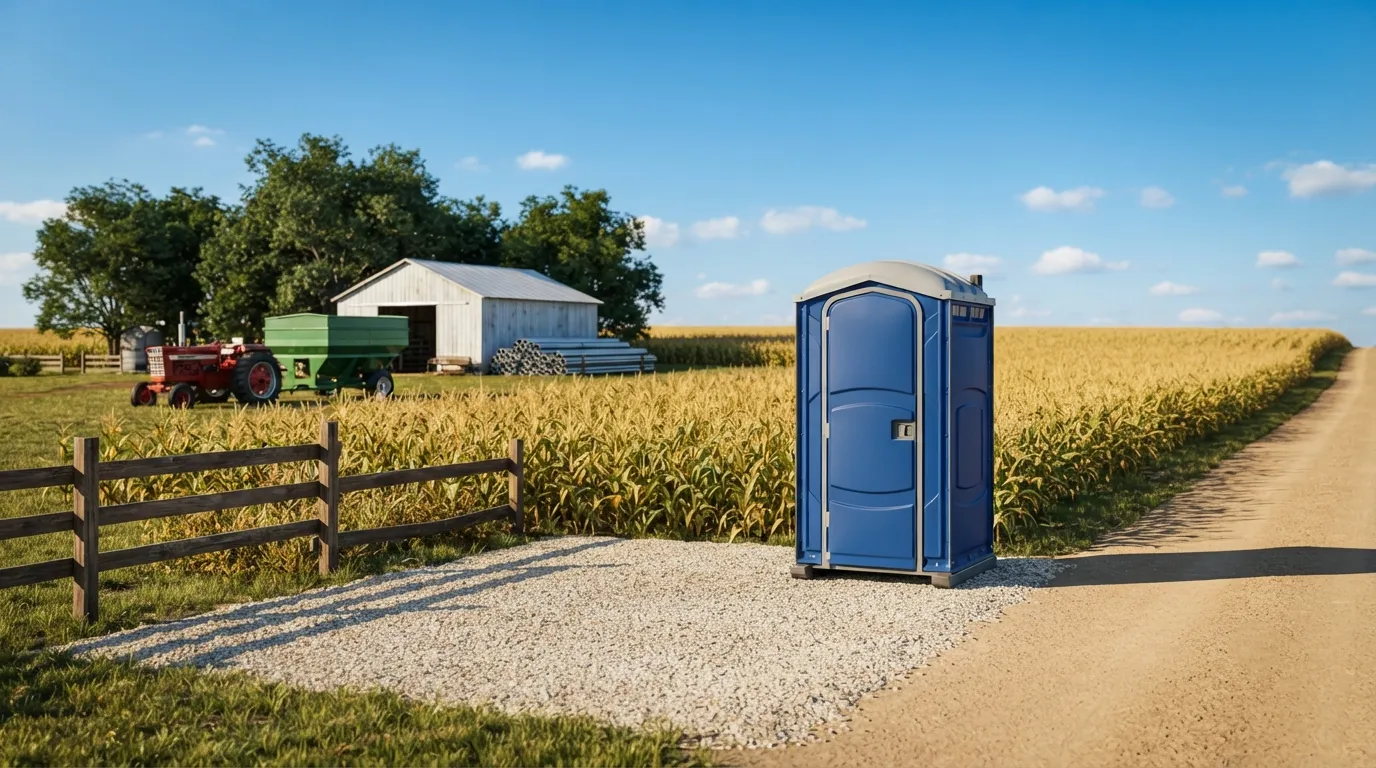
A standard unit works for most crews: it measures roughly 44 by 48 inches on the ground, so it fits between rows, along a fence line, or tucked beside a barn without eating up usable acreage. Bigger operations, or sites hosting a farm stand, u-pick event, or seasonal labor housing, often step up to a deluxe flushable porta potty or bring in a restroom trailer rental for crew comfort over a long season. If the crew includes anyone using a wheelchair or has mobility limits, ADA Standards section 213.2 requires that at least 5 percent of clustered single-user units be accessible, with a minimum of one, and an ADA accessible porta potty meets that with a 60 inch turning circle per ADA Standards 304.3.1. Ground stability matters on farmland too: ADA Standards 302.1 calls for a stable, firm, slip-resistant surface, which on working ag land usually means a gravel pad or compacted spot rather than loose dirt or mud. Santee sits inland from the coast, and delivery routes reach it easily from Bostonia, 4.8 miles southeast, and Winter Gardens, 6.6 miles east, which keeps service response quick for spread-out parcels. Pricing runs by duration, and most farm accounts land on weekly or monthly billing rather than daily.
| unit | day | week | month |
|---|---|---|---|
| standard | $100 - $350 | $130 - $500 | $125 - $325 |
| ada | $200 - $400 | $240 - $400 | - |
Check porta potty rental cost and monthly porta potty rental for the full breakdown, and porta potty rental per day if you only need coverage for a short harvest push.
Yes, and it is a distinct requirement, not an add-on. OSHA 1928.110 requires handwashing water alongside toilets for hand-labor crews, and 29 CFR 1910.141(d)(2) specifies soap and towels or a hand-drying device; hand sanitizer alone does not satisfy either standard. Any crew applying pesticides or herbicides triggers a second rule, OSHA 1926.51(f)(1), which requires washing facilities specifically because of that chemical exposure. A handwashing station rental or a portable sink rental covers both needs, and a hand sanitizer station rental can supplement but never replace them. Farms in Santee running seasonal labor camps sometimes also need a holding tank for wash water or gray water; a holding tank rental handles that overflow. If your farm includes a working septic system for a farmhouse or packing shed, a typical 1,000 gallon residential tank gets pumped every 3 to 5 years depending on tank size and household load, and septic pumping service or how often to pump a septic tank covers that separately from the field toilets. For sites needing quick turnaround before an inspection or harvest deadline, emergency porta potty rental fills gaps fast.
Monthly standard unit rentals run $125 to $325 depending on service frequency and unit count. Multi-unit farm accounts often negotiate a flat monthly rate across several clusters. See monthly porta potty rental for the full range and how service visits factor in.
ANSI/PSAI Z4.3 sets a baseline of one service visit weekly for up to 10 users across a 40 hour week. Field crews with heavier use, or hot-season demand, often need twice-weekly service. See how often are porta potties cleaned for details.
Yes, but the ground needs to be stable and level enough for safe entry, per ADA Standards 302.1. Loose or muddy soil causes tipping risk. Santee Porta Pros checks the site before delivery and recommends a gravel pad where needed.
Placement on private agricultural land generally does not require the same permit as public right-of-way placement, but that needs confirming with the city for your specific parcel. See porta potty permit requirements for guidance.
Unit count should scale with peak crew size, not average headcount, to stay within OSHA 1928.110 ratios. Santee Porta Pros adjusts unit counts month to month as harvest labor ramps up or down. Request a quote through Request a Quote.
Yes. Santee Porta Pros delivers farm and agricultural restrooms across Santee and the surrounding metro, with same-day and next-day drop-off available on most orders.
Pricing depends on the unit and how long you need it. See our cost breakdown and request a free quote for an exact figure.
Standard rentals include scheduled service — a pump-out, a clean, a restock and fresh deodorizer. Busy or hot-weather sites can be serviced more often.
Call now or request a free quote — clean units, on-time delivery, transparent pricing.